Product knowledge8 min readPublished 2026-11-12By the Karlead sourcing team
Lead-acid, NiMH or lithium: choosing the battery for a rechargeable torch
Two torches with the same LED count and the same price can have different batteries, and the battery decides almost everything the buyer experiences: runtime, weight, how long the torch lasts, how it charges and what it costs to ship. The catalogue's built-in-plug models run 4 V sealed lead-acid packs — here is how that choice compares with the alternatives, and when each is right.
The short answer
Sealed lead-acid (4 V or 6 V): cheapest per capacity, forgiving of over-charge, heavy — the default for built-in-plug household torches.
NiMH: no heavy metals, good cycle life, tolerant of partial charging, more expensive per capacity than lead-acid.
Lithium: lightest and strongest, but adds UN38.3 transport rules and a protection circuit to the specification.
The chemistry must be fixed before tooling, because the battery compartment, the charging circuit and the weight distribution all follow it.
Why built-in-plug torches usually run lead-acid
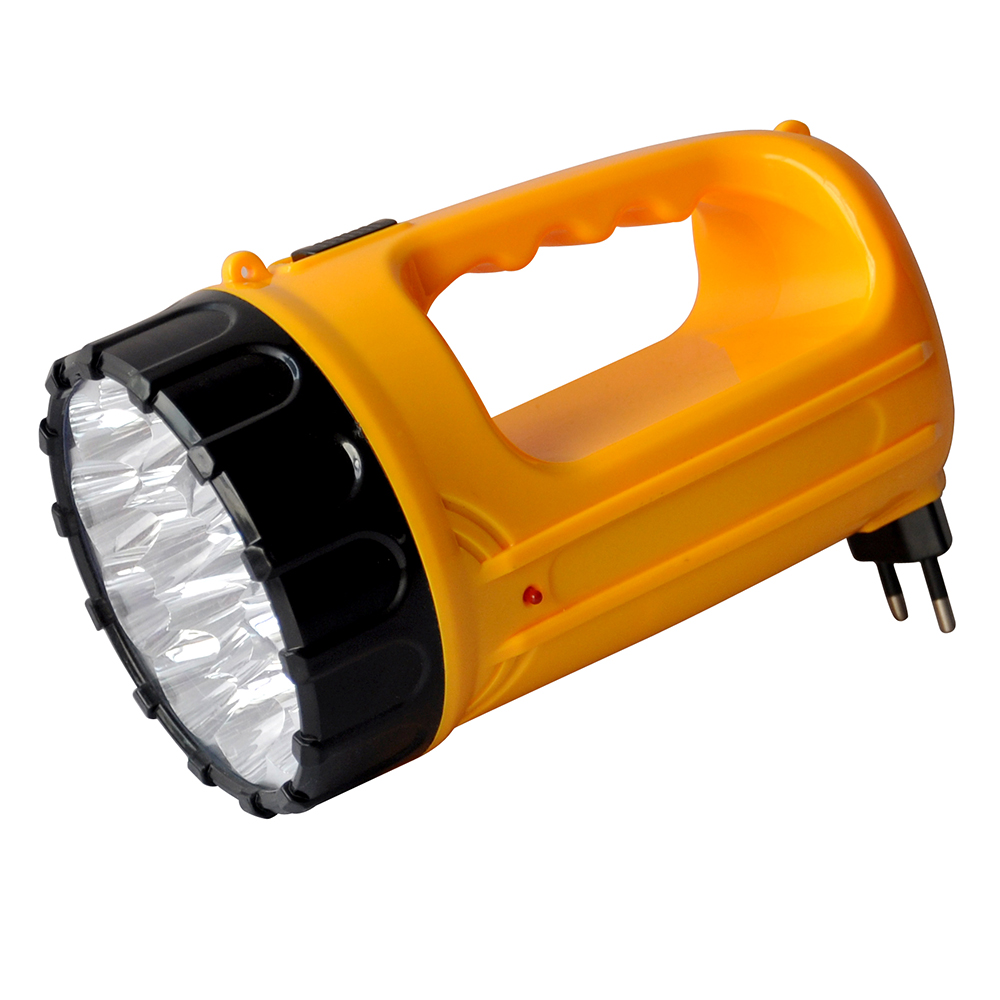
A torch that folds a mains plug into its handle spends its life on a shelf near a socket, trickle-charged and used a few times a year. That duty cycle is exactly what a 4 V sealed lead-acid pack does well: it tolerates permanent float charging, it is cheap, and it is robust against the charging discipline of a real household. The catalogue's Brazil-plug models follow this pattern — AT-615 and AT-611 both run 4 V 1200 mAh lead-acid packs, and AT-189 a 4 V 800 mAh pack, with charging from the built-in two-pin plug.
The trade-off is weight and cycle life. Lead-acid delivers fewer deep cycles than NiMH or lithium and weighs more per watt-hour. For a torch that lives by the fuse box, neither matters. For a torch that travels in a car or a pocket, both do.
The three chemistries side by side
Property
Sealed lead-acid (4V/6V)
NiMH
Lithium (Li-ion / LiFePO4)
Cost per capacity
Lowest
Middle
Highest
Weight per Wh
Heaviest
Middle
Lightest
Deep cycles (typical)
Hundreds
More
Most
Float / trickle charging
Tolerates permanent float
Tolerant of partial charge, dislikes prolonged over-charge
Needs controlled charging and a protection circuit
Cold performance
Capacity drops in deep cold
Moderate
Li-ion drops; LiFePO4 holds better
Transport rules
MSDS for freight
MSDS for freight
UN38.3 plus MSDS, SoC limit by air
A chemistry choice is a product choice: charging behaviour, weight and shipping cost all follow from this table.
Reading capacity honestly: mAh is not the whole story
Capacity in mAh is only comparable at the same voltage. A 4 V 1200 mAh lead-acid pack and a 3.7 V 1200 mAh lithium cell hold different energies; the honest unit is watt-hours — voltage times amp-hours. When a supplier quotes runtime, ask at what LED setting and to what endpoint, because "8 hours" at low beam is a different claim from 8 hours at the 1 W spot.
Charging behaviour and what it means for the plug
Lead-acid tolerates the simple constant charging that a fold-out mains plug provides, which is why the two go together in household torches. NiMH charges happily through a plug or a USB port but wants charging to stop when full. Lithium requires a controlled charge with a protection circuit, which the product must contain regardless of where the power comes from. This is one reason plug-socket torches at low price points are lead-acid while USB-C torches trend lithium or NiMH.
What each chemistry does to your freight bill
Lead-acid: no UN38.3, but forwarders still request the MSDS, and the weight raises sea freight cost per unit.
NiMH: no UN38.3, MSDS requested, lighter than lead-acid for the same energy.
Lithium: UN38.3 test summary for the exact pack, MSDS, state-of-charge limits by air, Class 9 labelling for standalone batteries — but the lightest volumetric load per unit shipped.
For a mixed container, the chemistry mix decides the document set. A buyer consolidating lead-acid torches with lithium jump starters manages two document tracks; a buyer standardising on one chemistry manages one. That is a real administrative saving on repeat orders.
Choosing by market, not by datasheet
Household and hardware retail in plug-standard markets — Brazil especially — favours the built-in-plug lead-acid torch: cheap, shelf-stable, always charged. Automotive and outdoor channels favour lighter packs and USB charging, where NiMH and lithium make sense. Premium gifting and workshop tools justify lithium. Fix the chemistry before tooling, because the housing, the charging circuit and the printed voltage marking are all downstream of it.
The current torch range is 4 V sealed lead-acid across the built-in-plug models, from the 800 mAh AT-189 to the 1200 mAh AT-611 and AT-615. Custom development from your sample can evaluate a different chemistry during the teardown stage.
Frequently asked questions
What battery do rechargeable LED flashlights use?
Three chemistries cover the category: sealed lead-acid at 4 V or 6 V for plug-charged household torches, NiMH for lighter mid-range models, and lithium for high-performance and USB-charged torches. The catalogue's built-in-plug models, such as AT-615 and AT-611 at 4 V 1200 mAh, use sealed lead-acid packs, which tolerate permanent trickle charging and keep the unit cost low.
How long does a lead-acid torch battery last?
Sealed lead-acid packs deliver on the order of hundreds of deep cycles and considerably more shallow cycles, which is the realistic duty for a household torch that sits on float charge and is used occasionally. Keeping the torch charged extends life; storing it empty for months shortens it. NiMH and lithium packs deliver more deep cycles and suit daily-use tools.
Is a lithium flashlight battery better than lead-acid?
Better for portable and daily use: lighter for the same energy, more deep cycles, and strong output. Not better for a shelf torch on permanent trickle charge: lithium needs a protection circuit and controlled charging, which add cost, while lead-acid tolerates the simple charging a fold-out plug provides. Choose by how the torch is actually used, not by chemistry reputation.
Do lead-acid flashlights need UN38.3 for shipping?
No. UN38.3 applies to lithium cells and packs. Lead-acid and NiMH products still usually require an MSDS from the forwarder, and lead-acid adds weight to the freight cost. If your order mixes lead-acid torches with lithium products such as jump starters, the lithium items carry their own document set.
Why is mAh not enough to compare torch batteries?
Milliamp-hours are only comparable at the same voltage, so a 4 V pack and a 3.7 V cell with the same mAh rating hold different energy. Watt-hours — voltage multiplied by amp-hours — is the honest unit. Runtime claims should also state the LED setting and the endpoint, because hours at low beam and hours at the 1 W spot are different claims.
Can the battery be changed after tooling?
Not easily. The battery sets the compartment dimensions, the charging circuit and the printed voltage marking, so a chemistry change after tooling means a new mould insert and a new sample approval. Fix the chemistry, the plug standard and the voltage marking before the housing tool is cut — all three live in the same decision.
How many times can I recharge a torch?
Depends on the depth of discharge and the chemistry. A lead-acid torch used occasionally and kept charged recharges for years; cycled flat regularly, its life shortens to hundreds of cycles. NiMH and lithium packs deliver more deep cycles and are the right choice where the torch is used and recharged daily. For a household standby torch, occasional-shallow duty is the realistic profile.
Which torch battery is best for cold climates?
Lithium iron phosphate (LiFePO4) holds capacity best in cold, standard Li-ion drops noticeably below freezing, and lead-acid loses capacity in deep cold but recovers. For a car-boot emergency torch in a cold market, ask for discharge data at the low end of your temperature range rather than the room-temperature datasheet figure.