Why lumens alone does not sell a torch
A torch is bought for a job: finding a fuse box, walking to a car in a power cut, inspecting an engine bay, or lighting a workbench. Each job needs a different beam and a different duty cycle. A single brightness figure tells you almost nothing about any of them, which is why two products with the same headline claim produce very different return rates.
The useful questions are how long the light stays above a usable level, how evenly it covers the working area, and whether the user can recharge it with the plug that exists in their home. Those questions are answerable from the data sheet and a short bench test.
Read the four lines together
| Model | LED configuration | Battery | Unit size | Pcs per carton | Charging |
|---|---|---|---|---|---|
| AT-189 | 7 LED / 7+3 LED / 1 W | 4 V 800 mAh rechargeable | 150 x 70 x 40 mm | 60 | Mains rechargeable, plug variant per market |
| AT-608 | 1 W + 8 SMD | 4 V 1000 mAh rechargeable | 190 x 95 x 60 mm | 48 | Built-in 2-pin AC plug (Brazil standard) |
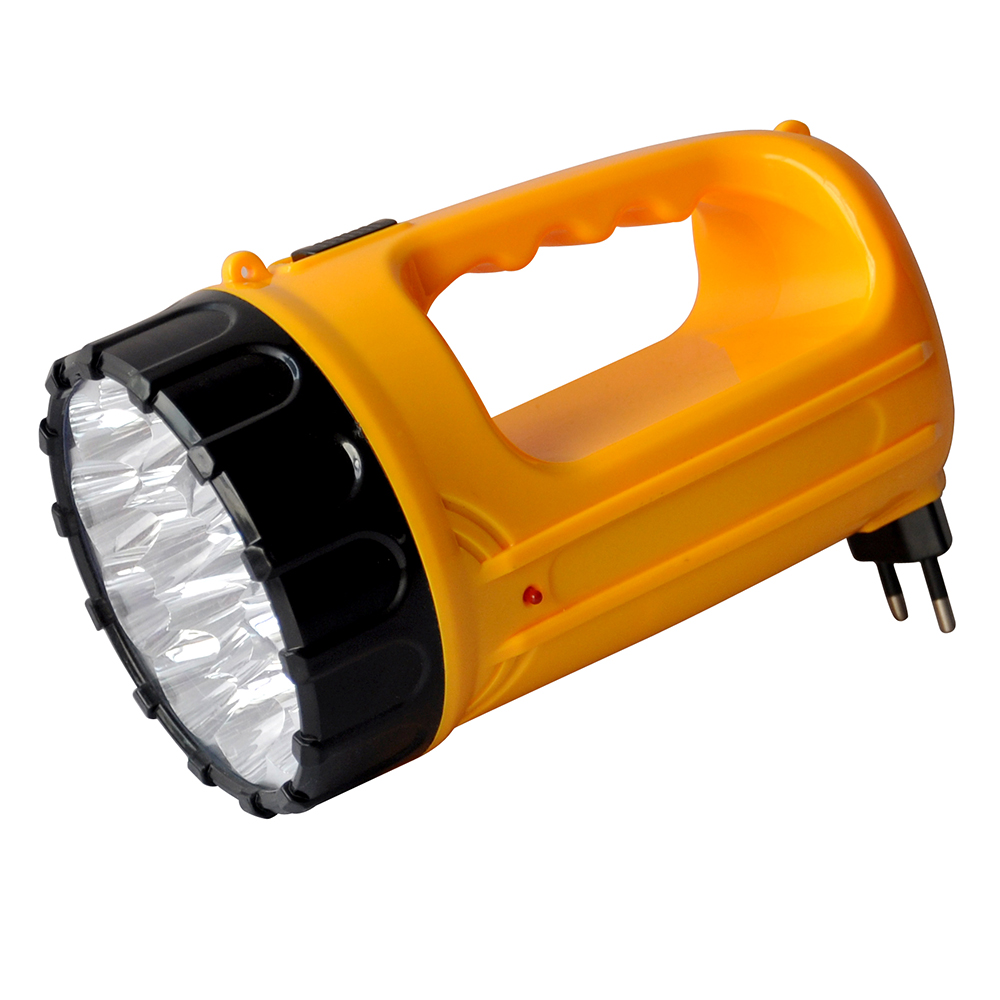
| AT-611 | 11 LED / 1 W | 4 V 1200 mAh rechargeable | 260 x 85 x 50 mm | 48 | Built-in 2-pin AC plug (Brazil standard) |
| AT-615 | 15 LED / 1 W | 4 V 1200 mAh rechargeable | 180 x 105 x 90 mm | 40 | Built-in 2-pin AC plug (Brazil standard) |
Read the table as a system. AT-189 combines a 7 LED head with a 4 V 800 mAh pack in a 150 mm housing and packs 60 units per carton. AT-615 combines 15 LEDs with a 4 V 1200 mAh pack in a wider housing and packs 40 per carton. A request for "the same torch, but brighter" is really a request to rebalance the pack, the optics and the carton.
Runtime is a curve, not a number
With a small sealed rechargeable pack, output declines as the cell discharges. A supplier quoting a single runtime should be able to say at what light level that time was measured. Ask for the time to half of the initial output as well as the time to full extinguish — the first is the number a user experiences, the second is the number that looks good on a carton.
- Request the measurement condition: fully charged pack, ambient temperature, and whether the reading was taken at the LED or at a fixed distance.
- Ask what happens after a deep discharge and a full recharge, because standby torches are often left discharged for months.
- For a light used daily, ask for cycle data. For a standby household torch, ask for storage and self-discharge behaviour instead.
- Agree the pass criterion in the purchase order: the light must stay above an agreed level for an agreed number of hours.
LED count, optics and the beam pattern
More emitters do not automatically mean a better working light. The reflector, the lens and the placement of the dies decide whether the user gets a tight spot, a broad flood, or a ringed pattern that looks poor on a wall. This is the part of the specification that photographs cannot replace.
- Take a beam photo on a plain wall at a fixed distance and keep it with the golden sample label.
- Count the lit dies in a dark room during a video call — an unlit position in a multi-LED head is a common cost saving.
- Check the switch sequence and whether a lower mode is genuinely lower or just a flashing mode.
- Ask whether side SMD emitters, where fitted, are on a separate switch and what their runtime is on their own.
The charging plug is part of the product
Built-in AC plug torches are market-specific. EU Europlug, UK BS 1363, US NEMA 1-15, AU/NZ and Brazil NBR 14136 differ in pin geometry, and mains voltage differs as well — Brazil uses 127 V in many regions and 220 V in others. The AT-608, AT-611 and AT-615 data sheets specify a built-in 2-pin AC plug (Brazil standard); AT-189 is listed with a plug variant per market. Put the standard and the voltage on the quotation, not just in an email thread.
A bench test any importer can repeat
| Test | Method | What to record |
|---|---|---|
| Initial output | Fully charged unit, fixed distance, same meter position | Reading at switch-on and after a short settled period |
| Runtime | Run to the agreed light level, then to extinguish | Both times, plus the ambient temperature |
| Beam pattern | Photo on a plain wall at a fixed distance | Spot size, ring artefacts, flood coverage |
| Charging | Time from empty to full with the market plug | Duration, housing temperature, indicator behaviour |
| Recovery | Deep discharge, storage period, recharge, repeat output test | Difference from the first-day reading |
| Drop and switch | Agreed drop height, then a switch-cycle count | Housing, lens, solder joints, mode sequence |
Turning the test into a written specification
- Model number, LED configuration and pack capacity as on the approved data sheet.
- Output and runtime with the measurement method and the pass level.
- Beam photo reference and the agreed mode sequence.
- Plug standard and mains voltage for the destination market.
- Housing colour, logo method, packaging version and manual language.
- Golden sample reference: sealed, signed and dated, held by both sides.