LED Flashlights & Automotive Accessories · Ningbo, China · sales@karlead.com

Shop by Category: Torches, Jump Starters, Inflators & Car Care

Swipe left to see all 8 categories →

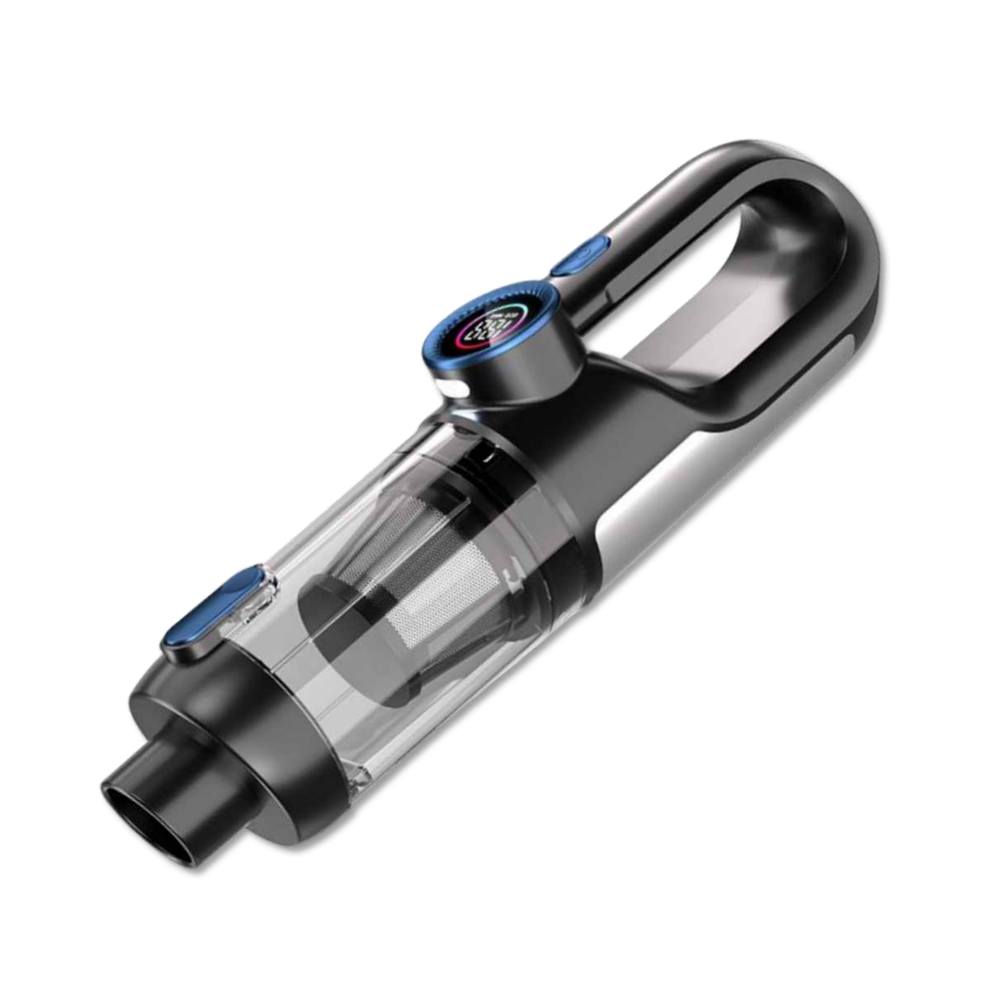
Car vacuum cleaners: suction, filtration and noise — the specification that decides quality

Car vacuums are among the most re-quoted products in car care because nearly any supplier in the Ningbo cluster can assemble one — and the specifications that separate a durable unit from a retail return are rarely printed on the quotation. This guide lists the questions to ask, and what each answer tells you about the unit you will actually receive.

The short answer

  • Motor type is the first fork: brushed motors cost less and are acceptable at entry price points, while brushless motors run longer, quieter and with a longer service life.
  • Compare suction in kPa or Pa at the same nozzle and the same gear, never motor wattage alone — two units with the same wattage can differ by more than double in measured suction.
  • Filtration decides how fast suction degrades in use: a cyclone or pre-filter stage plus a washable HEPA-style main filter keeps airflow far longer than a single felt filter.
  • The accessory kit and the reach of the cord or hose drive retail satisfaction as much as raw suction — check crevice tool, brush nozzle, extension hose and the packed length.

Brushed or brushless: the first fork in the road

Small handheld vacuums use either a brushed DC motor or a brushless motor. Brushed motors are cheaper and have been in production for decades, which makes them the default at entry price points. Brushless motors cost more per unit but run cooler, last longer on the same battery and are noticeably quieter at equivalent suction. For a retail program above the entry tier, brushless is what the specification should say — in writing, because the two look identical from the outside.

The catalogue illustrates the range: AC-2466 is offered in a brushed version at 5,000 Pa and a brushless version at 13,000 Pa in the same 7.4 V platform, while AC-1001 runs a brushless motor on an 11.1 V battery with a two-gear selector — 10 kPa on standard and 17 kPa on boost. Same category, three different product realities.

Reading suction numbers that mean something

Suction is quoted in kPa (kilopascals) or Pa. Two rules make the figures comparable. First, compare at the same measurement point: suction at the motor housing is always higher than suction at the nozzle end of the hose, and the honest figure is the one the buyer experiences. Second, compare on the same gear: a two-gear unit quoting only the boost figure is quoting its worst-case runtime mode.

ModelMotorRated voltageSuctionNet weight
AC-1001Brushless11.1 V (lithium)10 kPa standard / 17 kPa boost0.63 kg
AC-2466 (brushed)Brushed7.4 V5,000 Pa0.34 kg
AC-2466 (brushless)Brushless7.4 V13,000 Pa0.36 kg
AC-2166BrushedDC 12 V in-vehicle / 7.4 V lithium5,000 Pa0.713 / 0.716 kg
Figures from the current catalogue. Note that the two AC-2466 versions differ by 20 g in weight and roughly 2.6× in suction — the motor, not the housing, is the product.

Filtration: where cheap units give up

A vacuum loses suction as its filter loads with dust. The filter stack is therefore a better predictor of long-term performance than the day-one kPa figure. Look for three things: a cyclone or mesh pre-filter that lets coarse debris drop out of the airstream, a main filter rated HEPA-style for fine dust, and a washable construction, because a filter the buyer cannot clean is a filter that quietly kills the product at month three.

Ask the supplier to state the filtration stages and whether the main filter is washable. If the answer is "one filter, yes washable" at a boost-mode price, expect the suction curve to fall faster than the datasheet implies.

Power source: three products wearing one name

  • Cordless lithium models (7.4 V or 11.1 V packs): sell on convenience, carry lithium transport rules, need a charging method in the box — AC-1001 uses USB-C fast charging.
  • In-vehicle 12 V models: plug into the cigarette socket, lowest cost, but run only while driving and are limited by socket fuse rating.
  • Dual-source models: AC-2166 ships in an in-vehicle version and a lithium-battery version on the same platform, which lets a distributor serve both channels without two supply chains.

Decide the channel first — retail shelf, marketplace, workshop or fleet — and let the channel pick the power source. Ordering a cordless unit for a workshop channel, or a 12 V unit for retail gifting, is a specification error no factory can fix in production.

Accessory kit and packing: the unglamorous margin

The accessory kit is where quotations quietly diverge. A complete kit — crevice tool, brush nozzle, extension hose and a washable filter — adds cost but is the difference between a five-star and a three-star review. Check the packed reach: a hose plus wand that reaches the boot of a sedan needs roughly a metre and a half of working length, and a shorter kit gets used once and retired to the glovebox.

Packing math also differs by model: AC-1001 packs 12 pcs per 52.5 × 35 × 35 cm carton at 14 kg gross, AC-2466 packs 30 pcs per carton at 15 kg. Compute the container fill per model before you commit the split — the lighter carton is not automatically the cheaper freight.

Quality gates for the purchase order

  1. 100% run test: every unit switched on, run and checked for abnormal noise before packing — a bearing fault is audible in the first ten seconds.
  2. Suction sampling: a gauge check on a sample of units per lot against the quoted kPa, at the nozzle, on the quoted gear.
  3. Filter fit check: correct filter installed and seated, since filter variants ship loose and are a known assembly error.
  4. Carton drop test: vacuums are dense goods; a recorded drop test protects the lithium pack and the housing joints.
  5. Accessory completeness count: a missing crevice tool in a sealed retail box is a marketplace return even when the vacuum is perfect.
Lithium versions need the same transport discipline as any lithium product: request the UN38.3 test summary and MSDS for the exact pack at quotation stage, not at booking.

Frequently asked questions

How much suction does a car vacuum need?

For general interior cleaning, around 5,000 Pa handles floor mats and seat surfaces, while 10 kPa and above lifts embedded dirt and pet hair from upholstery. Boost modes above 15 kPa approach corded workshop performance but drain the battery faster, which is why a two-gear selector — like the 10 kPa / 17 kPa arrangement on AC-1001 — is more useful than a single high figure.

Is a brushless car vacuum worth the extra cost?

Usually yes above the entry tier. A brushless motor runs cooler and quieter, extends battery runtime on the same pack, and has a longer service life because there are no carbon brushes to wear. The AC-2466 platform shows the price of the gap: 5,000 Pa brushed versus 13,000 Pa brushless on the same 7.4 V battery, at almost identical weight.

Can a car vacuum handle wet spills?

Only a model explicitly built for wet/dry use, with a different motor protection and a separate liquid collection path. Standard dry-only units fail immediately on liquid, and the failure is not covered as a defect. If your channel sells wet/dry claims, confirm the wet capability in writing and check that the filter is a wet-rated type.

What is the difference between kPa and Pa on vacuum specifications?

They are the same unit at different scales: 10 kPa equals 10,000 Pa. A "5,000 PA" listing and a "5 kPa" listing describe the same suction. The comparison trap is not the unit — it is whether the figure was measured at the nozzle or at the motor housing, and on which gear.

How long does a cordless car vacuum run per charge?

Runtime depends on the battery capacity, the gear selected and the motor efficiency, so it should be quoted per gear rather than as a single number. Standard mode typically runs several times longer than boost mode on the same pack. Ask for the runtime on each gear next to the charging time — a unit that charges in one hour but runs four minutes on boost is a workshop tool, not a retail one.

What accessories should a car vacuum kit include?

A crevice tool for gaps between and under seats, a brush nozzle for dashboards and delicate surfaces, an extension hose or wand for the boot area, and at least one spare or washable filter. USB-C charging on lithium models matters for retail — buyers already own the cable.

What is a typical MOQ for car vacuum cleaners?

MOQ is quoted per model and rises with custom colours, printed retail boxes and logo printing. Neutral product on an existing mould starts lower than branded retail packaging. Because carton counts vary widely by model — 12 pcs for the large AC-1001 against 30 pcs for the compact AC-2466 — ask for the MOQ expressed in cartons as well as pieces, so you can plan the container mix.

Do lithium car vacuums need special shipping documents?

Yes. A UN38.3 test summary for the exact cell or pack and an MSDS are requested by forwarders and airlines, air freight caps the state of charge, and standalone batteries carry Class 9 labelling. Request the documents with the quotation, because a pack substituted after quoting invalidates the paperwork.

Need this quoted for your market?

Tell us the model, the destination and the plug standard. We reply with tooling, unit price, MOQ and lead time.

Contact us