What "Brazil standard plug" actually means
NBR 14136 is the Brazilian standard for plugs and sockets. The two-pin version used on small appliances and rechargeable torches has round pins in a recessed socket: 4.0 mm pins for the 10 A rating and 4.8 mm pins for 20 A. The three-pin version adds a flat earth pin, which a double-insulated torch does not need.
Physically the 4.0 mm two-pin plug is close to the European Europlug, which is why EU stock sometimes "works" in Brazil. That is not the same as being correct: the socket is recessed, retail buyers expect the plug to seat without an adapter, and a plug that fits loosely generates returns. For a retail program, specify the mould to NBR 14136 dimensions and say so on the purchase order.
Why built-in-plug torches sell in Brazil
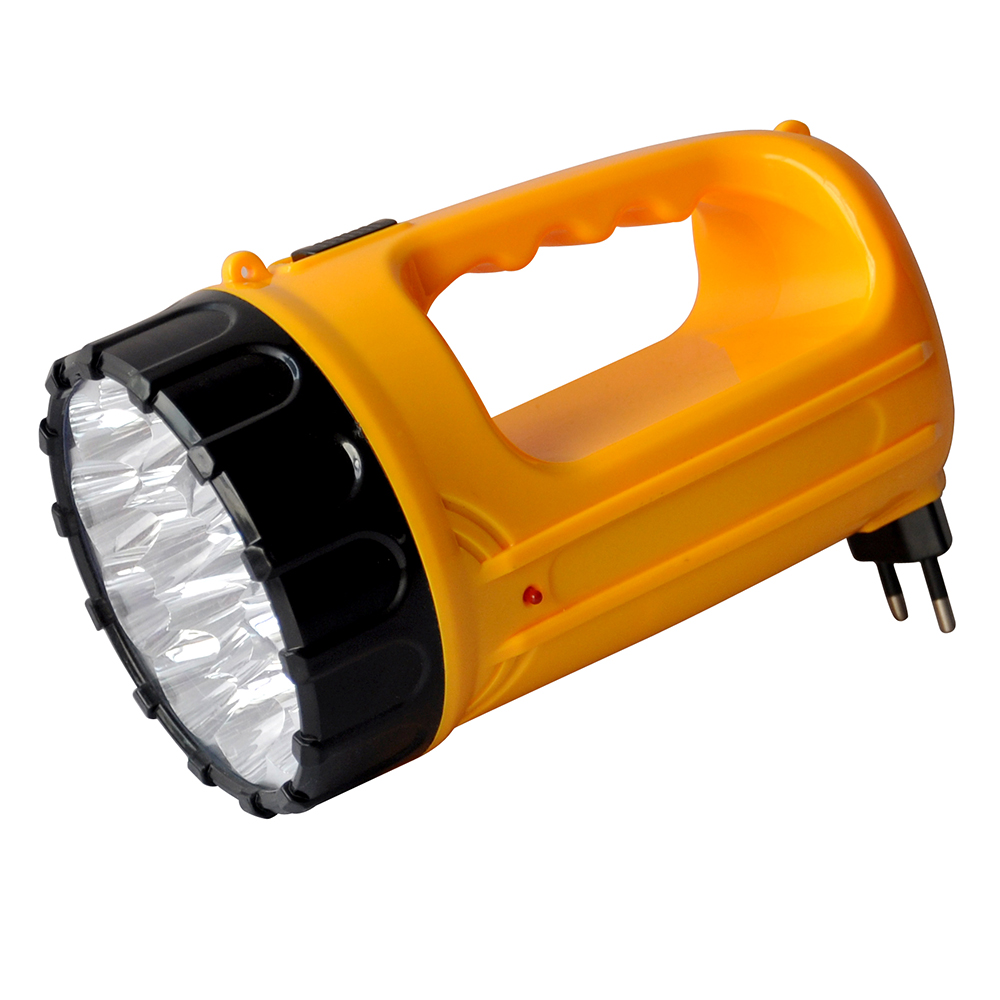
A torch that folds its own two-pin plug out of the handle removes the charger from the purchase. There is no wall adapter to lose, no USB cable to fail, and no separate power supply to certify or stock. In a market where a large share of torches are sold through hardware stores, street markets and marketplaces at low price points, that simplicity is the product.
The trade-off is that the plug is a moulded part of the housing, so the plug standard is fixed at tooling. You cannot convert an EU-plug housing into a Brazil-plug housing by changing the carton — it needs a different mould insert or a different housing.
Voltage: 127 V or 220 V?
Brazil runs two distribution voltages. 127 V is standard in São Paulo, Rio de Janeiro and much of the Southeast and Centre-West; 220 V is standard in the Northeast, the North and parts of the South, and some states use both within the same city. A torch designed for 127 V will charge slowly or not at all on 220 V, and the reverse can overheat the charging circuit.
- Selling into one region: specify that region's voltage only, and print it on the housing and the box.
- National retail or marketplace: split the order by voltage, or specify a wide-input charging circuit if the platform allows it.
- Never ship a single-voltage product without a voltage marking — it is the most common cause of a return in this category.
Import notes: classification, scope and documents
| Item | What to confirm |
|---|---|
| HS classification | Portable electric lamps generally sit under 8513.10. Confirm the NCM code with your Brazilian broker before the order, not after. |
| INMETRO | Compulsory certification applies to defined product families. Whether a rechargeable torch is in scope depends on classification and intended use — ask your importer of record to confirm, and request the test reports you would need if sampling is required. |
| ANATEL | Not applicable to a torch with no radio. It becomes relevant only if you add Bluetooth or another wireless function. |
| Label and manual | Consumer products in Brazil are expected in Portuguese. Budget for pt-BR artwork, not a sticker over an English box. |
| Battery transport | Lithium packs need UN38.3 plus MSDS for air freight; lead-acid and NiMH packs still need the MSDS. |
The Brazil-plug range: seven models, real specifications
| Model | LED configuration | Battery | Unit size (mm) | Pcs / carton |
|---|---|---|---|---|
| AT-605 | 5LED + 1W | 4V 400mAh rechargeable | 160 × 50 × 40 | 72 |
| AT-607 | 7LED + 1W | 4V 800mAh rechargeable | 150 × 80 × 60 | 48 |
| AT-608 | 1W + 8SMD | 4V 1000mAh rechargeable | 190 × 95 × 60 | 48 |
| AT-609 | 9LED + 1W | 4V 700mAh rechargeable | 210 × 65 × 45 | 48 |
| AT-611 | 11LED + 1W | 4V 1200mAh rechargeable | 260 × 85 × 50 | 48 |
| AT-612 | 7LED / 9LED / 12LED + 1W | 4V 800mAh rechargeable | 205 × 70 × 50 | 48 |
| AT-615 | 15LED + 1W | 4V 1200mAh rechargeable | 180 × 105 × 90 | 40 |
Packing details Brazilian buyers check
- Voltage marking on both the housing and the retail box, in Portuguese.
- Plug pins protected so they cannot pierce the box in transit — a common cause of damaged returns.
- Carton quantity that matches the pallet pattern you actually receive; 40 and 48 pcs cartons behave differently on a mixed pallet.
- Barcode and, if you sell on marketplaces, the inner-case label your fulfilment partner scans.